Holyrood Election Guide for Animal Supporters
The final list of the regional and constituency candidates standing for the Holyrood 2026 elections has been published ahead of the vote on the 7th of May.
In this article, you can find out more about the candidates you can vote for, how to contact them ahead of the election, and what they stand for in terms of animal welfare.
How to contact the candidates
If you have concerns that you would like to contact the candidates about ahead of voting, you can find out more about each of the constituency and regional candidates you can vote for, including how to contact them, on the Electoral Commission or Who Can I Vote For? website.
Who supports what?
All of Scotland’s main political parties (the Scottish National Party, or ‘SNP’, the Scottish Conservatives, Scottish Labour, Scottish Greens, Scottish Liberal Democrats, and Reform UK) have launched their manifestos.
Read on to see where each party stands on ensuring animal welfare is not put on the back burner, and which ones rise above the others in their commitments to improving existing standards for animals...

The past 5 years has seen the SNP make some good decisions for animals while in Government, such as establishing the Scottish Animal Welfare Commission, banning the use of wild animals in travelling circuses, supporting measures to reduce livestock worrying, supporting Mark Ruskell MSP’s Greyhound Racing (Offences) (Scotland) Bill which saves Greyhounds from injury, abuse and death on oval tracks, as well as supporting Christine Grahame MSP’s Welfare of Dogs (Scotland) Bill (2025), which is intended to crack down on puppy farming and encourage responsible care of dogs. Both of these Bills were passed before Parliament dissolved earlier this year. The SNP also introduced the Wildlife Management and Muirburn (Scotland) Act 2024, with the aim of reducing wildlife crime.
However, the SNP failed to take into account increased animal suffering at Scottish abattoirs and repeatedly resisted calls to bring the salmon farming industry under control.
In the SNP’s manifesto, the party commits to supporting the fishing sector and improving fish welfare, specifically in terms of wild salmon, noting that it is “determined to take actions to support wild salmon and the businesses which depend on them.” However, the party's commitment to improving fish welfare is contradictory, given the SNP's support for the fishing sector and salmon farming. You cannot support the very industry that threatens wild salmon stocks while claiming to support wild salmon. Additionally, the party commits itself to supporting the agriculture and farming sector, with the intention of introducing changes to make it more nature and climate friendly, but neglects to take into account ongoing abuse of animals within farming and agriculture.
The Scottish Conservatives have pledged to “ditch anti-farming policies that harm our agriculture sector, like the 2045 net zero target that requires less meat-eating and widespread culling of farm animals to cut emissions.” While stopping widespread culling of farm animals is something that we support, we recognise that more humane and non-lethal methods still need to be employed to mitigate the negative impact of certain species on the environment. Furthermore, the Scottish Conservatives mention supporting the salmon farming industry in its manifesto, something which we vehemently oppose. Salmon farming is both inhumane and unsustainable. More generally, the party has committed to “championing rural and coastal Scotland”, including extra funding for farmers and fishermen.
Scottish Labour makes a manifesto commitment to advancing animal welfare, with plans to introduce compulsory microchipping of cats, conduct a review and consolidation of wildlife legislation, “to strengthen and clarify wildlife and animal protection laws”, introduce a ban on the use of shock collars, develop a list of “permitted species” which can be kept as pets, “to reduce the keeping of exotic animals in unsuitable domestic conditions”, and work with farmers to improve animal welfare, including “a strategy to target rural veterinary shortages and phase out the use of farrowing crates.” Additionally, the party says that it will protect postal workers and the public from dangerous dogs, by “enhancing regulation and ensuring owners are held to account for dog bites and attacks,” reward farmers for nature-friendly practices, and support sustainable fishing practices. However, it also mentions building on production of farmed salmon, as well as investing in local abattoirs and fish processing facilities.
The Scottish Greens’ manifesto contains a dedicated section to animal welfare, in which the party commits to reviewing and updating Scotland’s animal welfare laws, taking into account “animals’ sentience, agency and welfare needs, as well as expanding the range of species protected under law”, reviewing legislation which protects wildlife to make enforcement easier, banning shock collars for cats and dogs, clamping down on the trade of exotic pets by introducing new legislation and regulations, rolling out a new public education campaign to raise awareness of the needs of exotic species, and tougher regulations on fireworks. The party also commits to the phasing out of harmful agricultural practices, such as the abuse of antibiotics to stimulate unnatural growth, the use of farrowing crates for pigs and cages for chickens, and the killing of day-old male chicks, and making a swift transition to welfare and nature centred farming, with regulations to support “livestock with plant-rich diets, cage-free rearing, and calf-at-hoof dairying, as part of broader regenerative farming practices.” The Scottish Greens says that it aims to turn Scotland into “a world-leader in farm animal welfare” and will oppose UK Government moves to sign up to trade deals that would bring down the country’s high standards.
The Scottish Liberal Democrats’ manifesto focuses on supporting farmers, crofters, and fishermen, with commitments to making the sectors more sustainable and nature-friendly, but fails to make any clear commitments to animal welfare. In terms of farming, the party commits to backing an agreement between the UK and EU to allow for “enhanced access for UK food and animal products to the single market, with minimal need for checks or documentation”, reversing declining livestock numbers to support production of animal products, and removing “logistical challenges” to the movement of livestock. The party also commits to tackling overgrazing by deer and “boosting the low-carbon wild venison market.” However, the party does note that “Scotland is facing a nature crisis. One in nine species are threatened with national extinction” and has committed to enhancing Scotland’s natural landscapes in an attempt to save species from extinction and improve the environment. In terms of fishing, the party commits to ending industrial-scale gill net fishing by foreign vessels, as it damages Scottish fish stocks, among other measures which would support more fishing in Scotland. However, the party does commit itself to working with stakeholders to “deliver a national plan to cut whale and dolphin bycatch and reduce underwater noise.”
Reform UK’s manifesto reveals that one of the party’s main commitments is to investing in farming and fishing, much like the Scottish Conservatives. In terms of farming, the party plans to “[s]upport abattoirs with apprenticeships to grow that workforce” and “[m]aintain Scotland’s premium reputation through Quality Meats Scotland and Scottish Quality Crops but ensure it is quality and welfare based, not ideological”. In terms of fishing, the party plans to “[o]ptimise fishing opportunities for Scotland’s fleet through annual negotiations and international agreements.” We give Reform's manifesto a giant thumbs down.
‘More for Scotland’s Animals’ Hustings
At More for Scotland’s Animals Hustings on the 14th of April, party candidates came together to form a panel to answer the public’s questions about animal issues. The panel consisted of Ben Macpherson (SNP), Joanna Mowat (Scottish Conservatives), Catriona Munro (Scottish Labour), Ariane Burgess (Scottish Greens), and Helen McDade (Reform UK). The Scottish Liberal Democrats were invited but unfortunately could not attend.
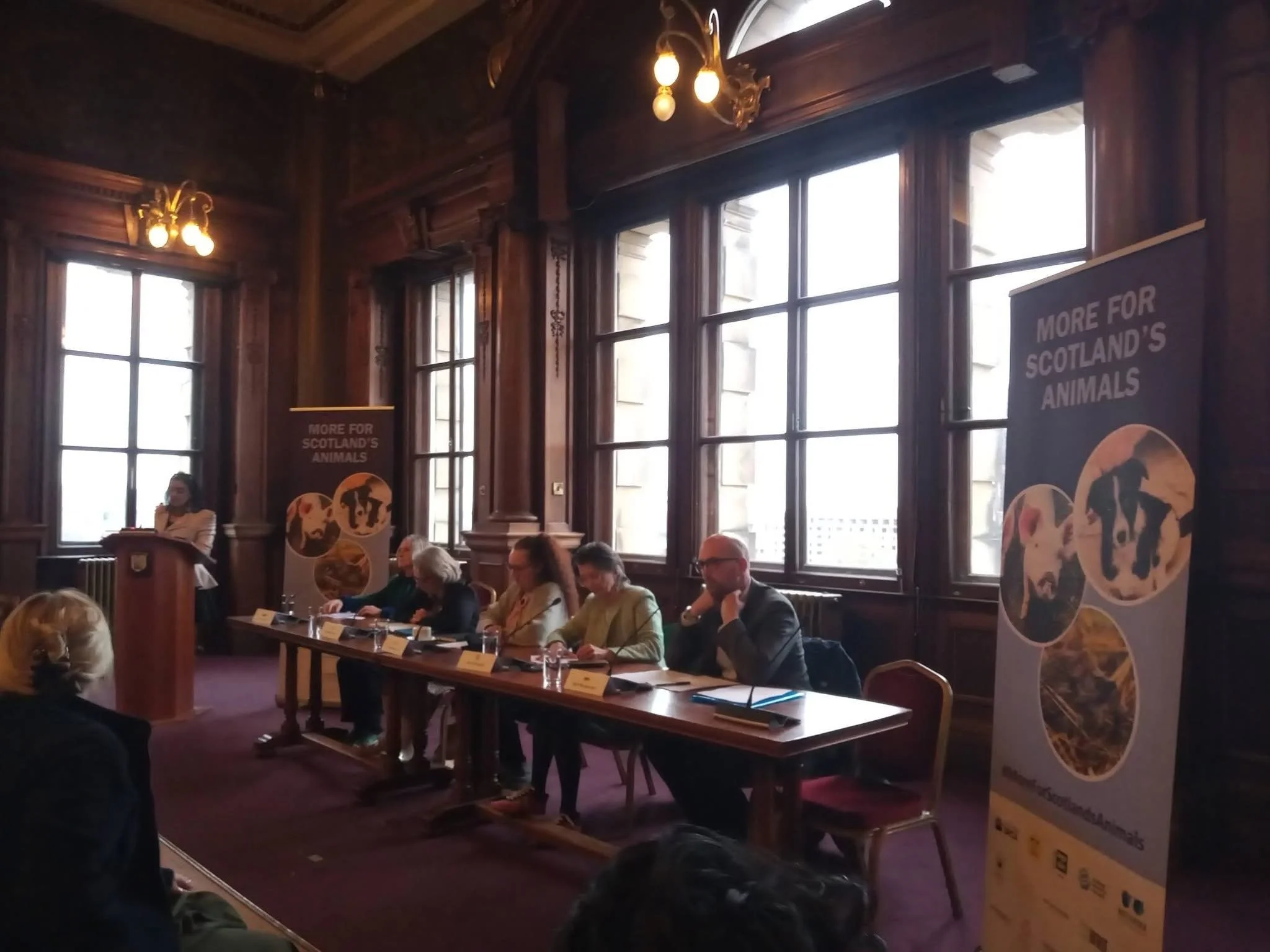
Photo from OneKind
During the Q&A portion of the event, the following topics were brought up by the audience:
Enforcement of legislation;
Farrowing cages;
Wild animals as pets;
How do the parties justify exploiting animals;
Banning shock collars;
Imports of meat post-Brexit driving up prices and adequate labelling to show inhumane products;
Farmed salmon (as well as fish in general) and legal protection regarding sentience;
Protecting raptors;
Compulsory microchipping of cats; and
Firework control zones (which was determined to be an issue for local councils rather than Parliament or Government).
Scottish Greens candidate Ariane Burgess came across as the most knowledgeable and committed to animal rights and welfare issues, highlighting issues such as problems with the salmon farming industry, the need to strengthen the ban on fox hunting, and raising awareness of sentience within fish and crustaceans.
Scottish Labour candidate Catriona Munro also seems to be committed to enhancing animal rights and welfare in Scotland, noting the numerous commitments the party has made within its manifesto, as referred to above. Although SNP candidate Ben Macpherson also came across as personally invested in animal issues, he was reluctant to commit the party to solving the topics discussed, due to its manifesto not yet being published.
Both the candidates from the Scottish Conservatives, Joanna Mowat, and Reform UK, Helen McDade, were mainly focused on supporting farmers and Scottish produce, though each noted personal interest in some of the issues discussed.
Animal Concern is contacting the parties’ representatives with our own questions about animal rights, which are:
1. Animal Concern has received statements from numerous equine welfare organisations and professionals supporting our call to ban the practice of shaving the majority of tail hair of the dock of heavy horses, an entirely unnecessary practice that deprives them the use of their natural tail. The Clydesdale Horse Society has made clear that they will not be told how to present their horses, therefore guidance will not be enough. Will you support legislation to ban the practice of shaving the tail hair off heavy horses?
2. You may be aware that the public has lost confidence in the salmon farming sector. The industry has proven itself incapable of managing mortalities caused by sea lice, disease, algal blooms and jellyfish, and severe storms leading to escaped farmed salmon has continued to jeopardise fragile wild salmon populations. Will you ensure the precautionary principle is adhered to and a moratorium on salmon farms be put in place with a view to remove existing salmon farms?
3. Currently there is a failure to protect wild bird species such as geese from culling practices that have proven to leave many geese suffering prolonged deaths. Will you support non lethal management of wild geese as well as urban pigeons and gulls, and ensure numbers of licensed killings by NatureScot are recorded and published?
4. What will you be doing to ensure an end to fox hunting, including the ongoing illegal fox hunting that occurs under the guise of trail hunting?
5. Currently legislation governing live animal research is reserved to Westminster and managed, under strict secrecy, by the Home Office. Would you support devolving the Animals (Scientific Procedures) Act 1986 from Westminster to Holyrood thus allowing animal research facilities to be monitored and policed by the Scottish Government?
6. The Scottish Government has continued to licence the annual killing of guga (young gannets) on the island of Sula Sgeir. There is no longer any justification for this barbaric practice of taking young gannets from their parents and bludgeoning them to death. It is cruel, inhumane, and entirely unnecessary. It is this lethal, outdated tradition that needs to die, not the gannets. Would you oppose granting of the Guga Hunt Licence if you are elected?
7. Noting that guidance does not allow for an end to cruel practices, Animal Concern and its supporters want to know; will you ensure legislation will be prioritised over guidance in matters pertaining to animal welfare?
Employment statistics are routinely used to excuse and endorse industries that profit off the exploitation and inhumane treatment of animals. This includes salmon farming, industrial scale farming of chickens, dairy cows and pigs as well as trail hunting, horse racing, and previously, greyhound racing.
We are asking each party what actions they are taking to move away from promoting jobs that exploit and cause harm to animals and the environment and focus on sustainable jobs that benefit both people and animals instead of jobs that enable ongoing animal abuse.
An update will be given in due course once responses are received.
Lastly, click here to see which party Animal Concern endorses.
Before you cast your vote for animals, don't forget to register by the 20th of April! Find out how to register here.
As always, thank you for your support for animals.