St Kilda’s Starving Sheep
St Kilda is a weather-beaten archipelago, off the west coast of Scotland, 40 miles from the Outer Hebrides. The cluster of islands, Hirta, Soay, Boreray and Dun, sit alone in the vast expanse of the unforgiving North Atlantic.
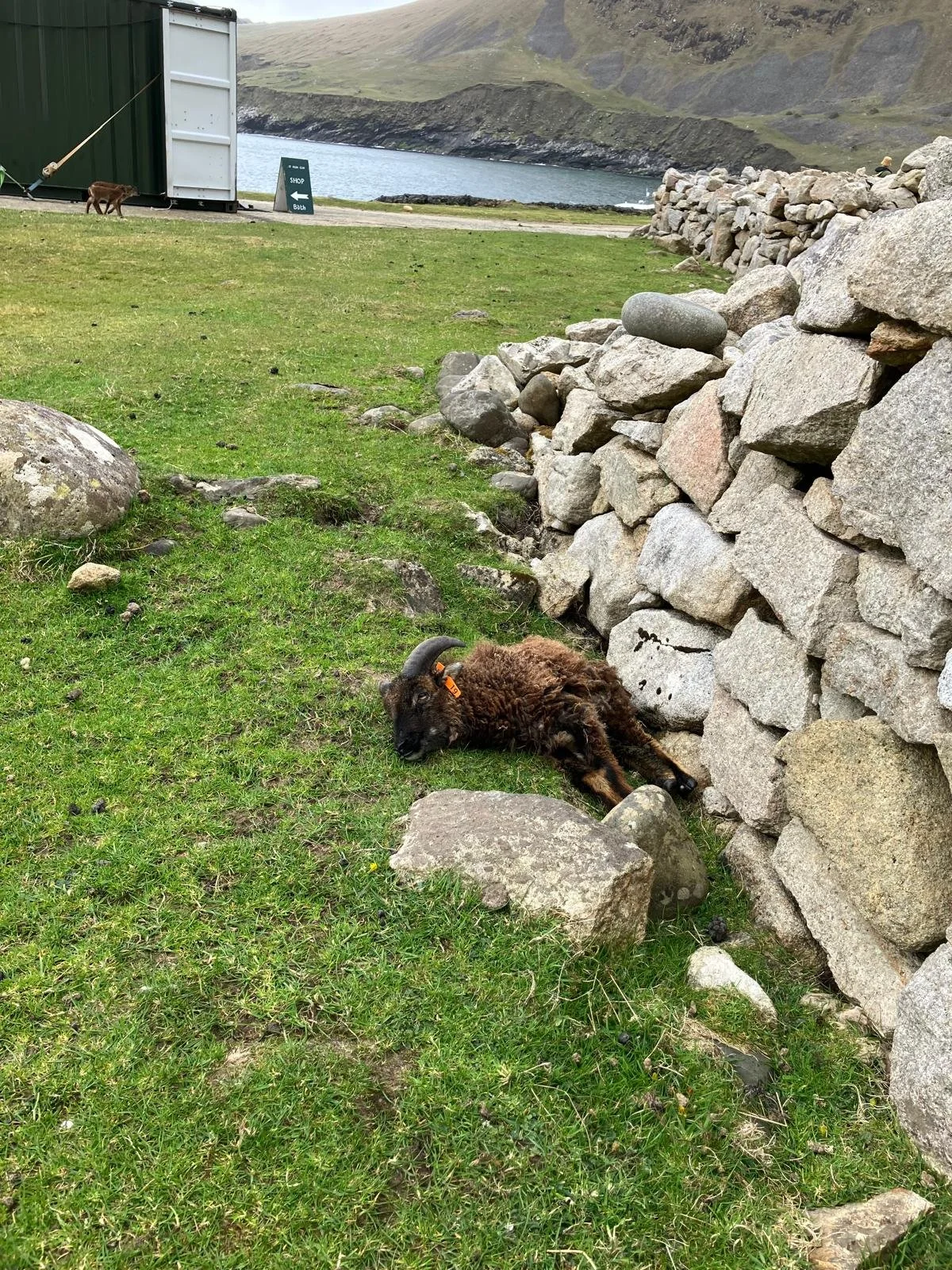
Although once populated, now only cleats remain. However, a more prominent reminder of human settlement are the abandoned sheep that fight for their lives on the islands, wholly unmanaged by the National Trust for Scotland, and left to starve in droves year-on-year.
Overview
Over the past decade, the concern of the Soay Sheep on St Kilda suffering annually through starvation and parasitic infections to the point of death has been documented and reported by David Buckland and Graham Charlesworth. Several others have also made submissions to the National Trust of Scotland (NTS) and the Scottish Government.
Recently, MSP Tim Eagle, submitted a question to Scottish Government, given that both the National Trust for Scotland and Scottish Animal Welfare Commission have been reviewing their stance since 2025, and early 2026.
NOTE: While a working group was set up to review the moral and ethical issues concerning the sheep by SAWC in 2025, with a review to be released by July 2026, as of September 2026, this review is still incomplete.
In 2023 a petition brought forward by David Buckland and Graham Charlesworth, asked the Government to ensure the definition of protected animals in the Animal Health and Welfare (Scotland) Act 2006 applies to the sheep on St Kilda.
Animal Concern have directly reached out to the National Trust for Scotland and the Scottish Animal Welfare Commission, for response.
Confusingly, the Scottish Government admits that the sheep are 'feral' but that for the purposes of the animal welfare legislation they should be regarded in the same way as wild deer and other wild animals.
The Legislation Decoded
The Government views that they are protected by the Wild Mammals (Protection) Act 1996, in the same way as any unowned and unmanaged population of wild deer. (Meeting 19/03/25) Under this legislation there is no 'duty of care' and no protection against starvation.
From the perspective of veterinarian David Buckland, who has been working alongside Graham Charlesworth, for almost a decade on this issue, the Soay Sheep of St Kilda fall clearly under the Animal Health & Welfare Act (2006):
Protected animals and responsibility for animals - Sections 17 and 18 of the act
Having established a definition for "animal", the Act then defines "protected animals". For an animal to be classed as a "protected animal" it needs to satisfy just one of the following conditions:
· it is of a kind commonly domesticated in the British Islands (animals that are of a kind commonly domesticated in the British Islands include feral domestic animals such cats, sheep, goats and ponies)
· it is under the control of man on a temporary basis (as, for example, where an animal is caught in a trap set by man; or where a wild bird is being ringed by an ornithologist) or on a permanent basis (as, for example in the case of farmed deer or ostriches, or penguins kept in a zoo)
· it is not living in a wild state (as, for example, where a parrot or non-native snake or reptile escapes from captivity and, not being native to the British Islands, cannot be said to be living in a wild state even though it is living in the wild)
The sheep clearly meet two of the three criteria, being commonly domesticated, and under the control of man. This begs the question of why the legislation is not being applied to them.
The SSP and National Trust for Scotland claim the sheep have been unmanaged for several millennia. This is false, with clear evidence from Alice MacLachlan's diaries. She was the schoolteacher on Hirta between autumn 1906 and spring 1909. Note the Gaelic word 'molt' referring to sheep brought from Soay: both words refer to castrated males, demonstrating that the inhabitants were castrating the males lambs on Soay.
The Soay Sheep Project - A Study of Starvation
A potential reason for the continued lack of action for these sheep, could be down to the Soay Sheep Project. Beginning in 1985, the researchers involved see the conditions as ideal for studying the population growth and decline and contributing environmental factors.
According to the The Soay Sheep Project: “The sheep system on Hirta represents one of the longest-running detailed studies of a plant-herbivore interaction anywhere in the world. From a botanical perspective, the system is ideal because the Soay sheep are the only large herbivores on the island (there are no rabbits and no voles), so all grazing impacts can be attributed unequivocally to the sheep. Similarly, the Soay sheep have no predators, so their population is clearly food-limited, and hence must be regulated by competition for food.”
The SSP argue that these deaths are comparable to large numbers of starvation related deaths in the reindeer of Svalbard, the Saiga antelope of Kazakhstan and the wildebeest of the Serengeti. We argue that the deaths of the sheep by starvation should not be labelled as “natural” as they would not naturally have arrived at the island where there are no natural predators, no means of migrating beyond the island for food sources, and where they are left to breed unchecked, creating a population beyond the island’s carrying capacity. A much better comparison would have been the winter starvation of large herbivores in the Oostvaardersplassen nature reserve in The Netherlands, where, as on St Kilda, the animals had no predators and could not disperse or migrate. Public outrage led to management to avoid overpopulation and starvation.
The inference is that SSP believe we should be less concerned about their welfare because they are wild animals.
Animal Welfare Ethics and Legislation
The Animals (Scientific Procedures) Act 1986 (ASPA) machinery provides a clear, unequivocal definition of wild and feral:
A wild animal species is one that has never been cared for or farmed by humans, and is not descended from domesticated individuals.
A feral animal is an animal living in the wild but descended from domesticated individuals.
Under ASPA, feral animals are ‘specially protected’ (even above the enhanced special protection afforded to “animals taken from the wild”):
Regulated procedures cannot be carried out on feral animals, unless specifically authorised in the project licence. Further, a project licence for a programme of work using feral animals cannot be granted unless:
the purpose of the programme of work can only be achieved by the use of such feral animals; and
the study is essential to protect the health or welfare of that species or to avoid a serious threat to human or animal health or to the environment.
The reason for this is that feral animals have undergone significant physiological changes, as a result of human husbandry practices and domestication. For example, in the case of sheep, many breed at 6-8 months old. This is completely at odds with wild sheep, who tend to reach breeding age from 2 years old onwards (example).
Despite the scientists describing their study animals as 'wild' in their applications for funding, in their research papers and in the media, FOI2026/00232 reveals that the sheep are deemed to be “Feral animals of a domestic species” by the Home Office and the SSP apply for their project licences on that basis.
Starvation Figures
‘… when the total number of sheep on Hirta exceeds approximately 1150, a high proportion of animals may die - in some cases over two-thirds of the population…The immediate cause of death in late winter is almost always starvation’ - T. H. Clutton-Brock in Soay Sheep (2004)
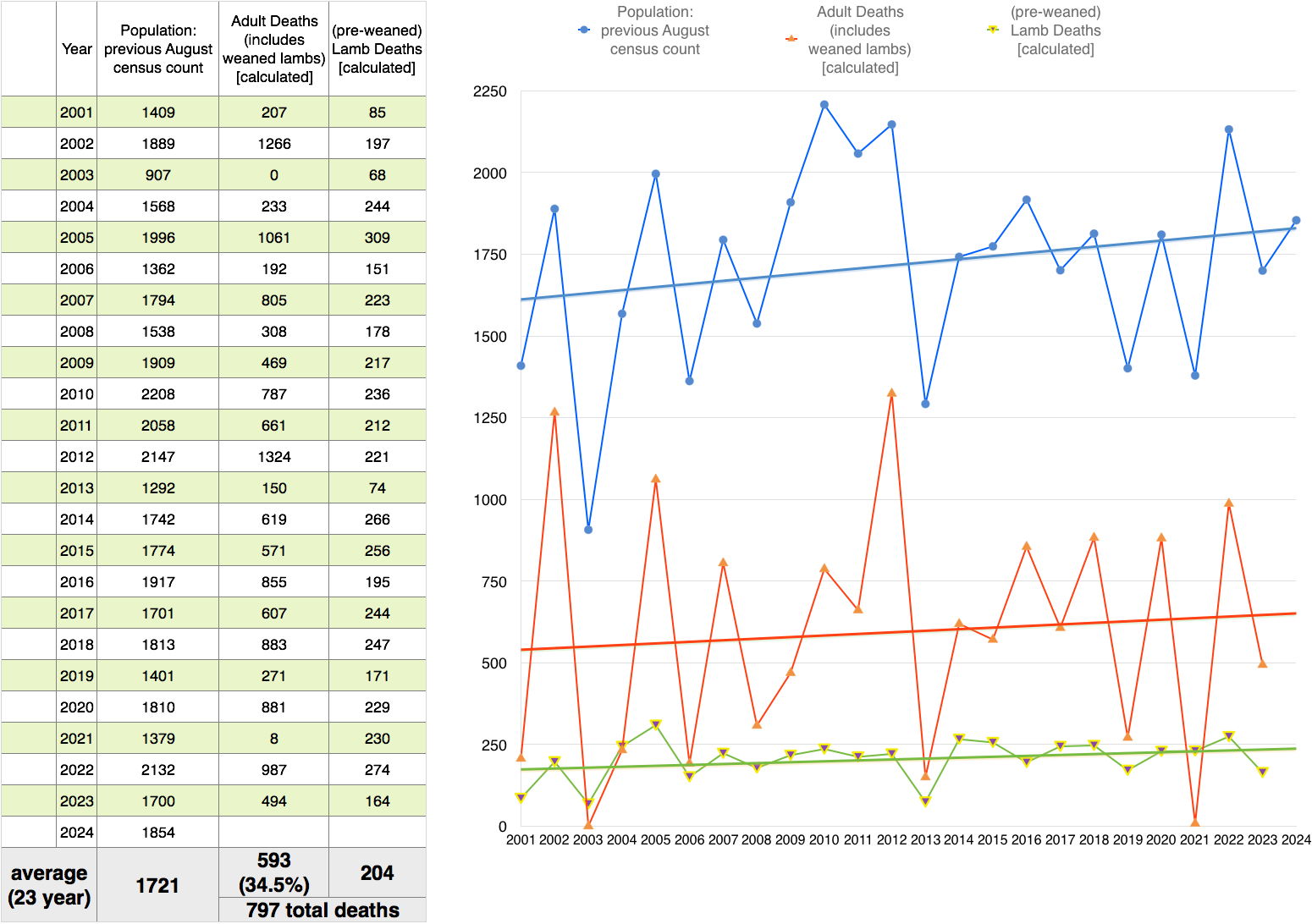
Data from Hirta population August censuses published in the Soay Sheep Project (SSP) Annual reports 2001-2023, as calculated by David Buckland and Graham Charlesworth, and verified by Professor Malcolm Kennedy
• the yearly average of adults and weaned lambs dying is just under 600 or 34.5% of the population and the trend is one of increase
• including young lambs, the yearly average total deaths is 797
• lamb mortalities calculated from the published Village Bay percentage lamb mortality and the Hirta August (surviving) lamb count, using the assumption that the percentage lamb mortality in Village Bay will apply to all of Hirta
• All mortalities are assumed to be due to starvation or parasitic disease, given that in the research papers, no other causes of death are provided for the ‘food limited’ population
• note that this is just Hirta: no good data is available for Soay or Boreray, though the sheep populations are known to suffer population ‘crashes’ synchronously with Hirta: the counts for Boreray range between 350 and 700 sheep on just 55ha of available grazing; Soay is 99ha and probably holds a similar number of sheep as Boreray
• it is likely that the yearly average number of adult deaths from starvation and parasitism across the 3 flocks exceeds 1000
importantly, it is not so much the number of animals dying that is of concern, it is the way in which the sheep die
What does the process of starvation look like?
Professor Ranald Munro, BVMS, MSc, DVM, Dip Forensic Medicine, MRCVS
Severe nutritional deficiency disease leading to death.
Starvation arises from severe and prolonged malnutrition. It is the end point of a downward spiral in the bodily condition of animals resulting from an inadequate (quantity and/or quality) diet. This downward spiral can be augmented by parasitism or other infections.
Like other ruminants, sheep require both protein and carbohydrate in their diet to grow and to maintain all bodily organs including skin, muscles, bones, brain, liver and kidneys. In the absence of sufficient grazing (or browse) of an adequate quality, sheep rapidly become protein-energy deficient.
In the early stages of this process, loss of bodily condition is often masked by their coat of hair/wool. Fat deposits, laid down in summer, under the skin, between the muscles, around the intestines, heart and kidneys, form the source of energy to maintain the body during the stressful winter period. As the source of suitable food diminishes in late autumn, the sheep may appear constantly hungry and may consume unsuitable indigestible material. As emaciation progresses appetite may decrease. The complex cycle of digestion in the first stomach (the rumen) which relies on micro-organisms to break down ingested grasses etc, begins to fail. The flow of nutrients from the stomachs slows. Fewer essential ingredients are passed to the intestines for absorption and onwards transmission to the liver for processing. Hypoglycaemia triggers increased use of the fat deposits. Another important factor associated with loss of activity in the first stomach is a reduction in heat generated by the myriads of these microbes. This loss of heat production in an animal that is already struggling to maintain its body temperature makes matters worse.
Once all the fat stores have been used to fuel the body, the only alternative is for muscle to be reabsorbed and metabolised for energy. The muscles of the back and legs are affected first followed by other muscle groups throughout the body. This breakdown of muscles also extends to the heart which becomes thinned and weakened. The liver (the vital powerhouse of the digestive system) becomes progressively smaller. All the internal organs shrink. Protein levels in the blood drop.
Utilisation of fat reserves and catabolism of muscle for the energy needed to sustain life in starved animals is accompanied by a shut-down of the energy used for the maintenance of healthy bones. Minerals and protein are reabsorbed, resulting in poor mineral density of the skeleton, decreased strength of bone cortex and increased risk of fractures. These bone fractures are very painful.
Video by Graham Charlseworth, showing a starving male sheep
“Clinically, these malnourished sheep are seen to be weak, thin and underweight. It is difficult for them to stand up. They sway and stagger when attempting to walk. They are easily caught. As prey animals this makes the sheep anxious and agitated. Eventually, too exhausted to move about, they lie down. They die. It is a slow, painful and hugely distressing death.” - Prof. Ranald Munro, 2016.