Contradicting Arguments on Shaving Clydesdales Tails, and why Guidance will not be enough
In the time since the practice of depriving heavy horses the use of their tails via shaving off the majority of their tail hair was raised as a welfare issue, the Clydesdale Horse Society (CHS) and Shire Horse Society (SHS) have repeatedly given contradictory excuses for why this practice must continue.
“Tradition” has been used often, with the CHS stating “The CHS stands by its traditions on this matter” and “We cannot instruct owners on how to sort the tails of their horses for showing.”
However, this matter must go beyond one’s preference for how to present a tail for showing purposes and the argument to maintain a tradition that has never benefitted the horse is not good enough.
“Safety”, the second argument for shaving the tail claiming it prevents the tail getting trapped in harness or straps, has long been debunked. While it is true that a non-existent tail cannot get caught in anything, it is not reason enough to deprive a horse the functions that its tail provides, especially given there are obvious alternatives to keep the tail out of harms way if that is a concern.
Many other horse breeds used to pull carriages or machinery do so with full tails, so this concern about safety necessitating the removal of most of the tail hair seems prominent only among Clydesdale and Shire horse owners.
It has been widely accepted that alternatives such as plaiting, bandaging or trimming are all that is required to keep a horse’s tail from any harm.
The CHS wrote that they have “never received a complaint from the vet of any Clydesdale horse owner condemning the traditional practise of tail clipping as being a welfare issue.” It is highly unlikely that a vet would complain to their client about a practice that has no legislative grounds, and this statement ignores the many that have been put forth by equine experts condemning the practice such as the BVA who stated; “We agree that tails are an important means of protection from flies, and carrying out a procedure which limits a horse’s ability to protect itself purely for cosmetic purposes is not justified.”
With the safety myth debunked, they have put forth tradition. The argument for maintaining any tradition that adversely affects the overall wellbeing of an animal cannot hold water.
Historically it was tradition to sever the docks of heavy horses that were routinely worked, but that tradition was banned upon recognising it was depriving horses the use of tails for communication, to deter pests, regulate body temperature and socialise.
It has already been acknowledged in the Docking and Nicking of Horses Act 1949 banning the docking and nicking of tails that it does not benefit the horse to have the use of its tail removed.
The same criteria should be considered in depriving horses the use of their tails via shaving the hair off the docks; it deprives horses the use of tails for communication, to deter pests, regulate body temperature and socialise.
With the arguments of safety and tradition debunked, hygiene has now become the argument that shaving the tail is in the best interest of the horse.
The response to the pressure to end tail shaving has been for prominent Clydesdale breeder at Collesie Feeds to post a video to "educate" people on the "real" reason they shave tails - hygiene.
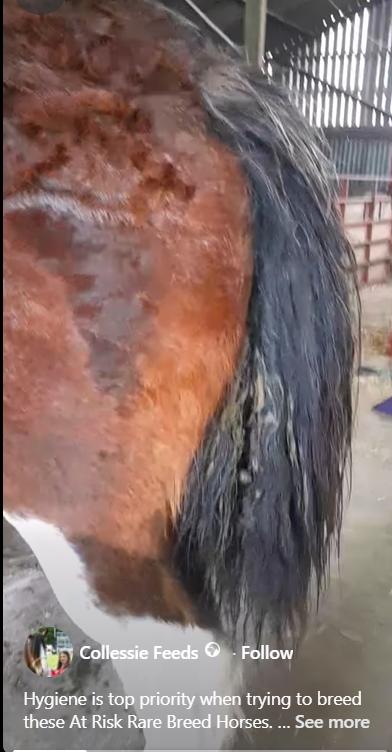
In the video, Mr Black claims that the reason they "reduce the volume of hair" in their tails to is to "improve their health and their hygiene".
He says "...and those who think horses need their tails for flies, here is the reaction if a fly lands on them...", and he then taps the horse in the flank area causing the horse's side to quiver in response.
Black goes on to say how Clydesdales are unlike any other horse, in that they are bred to have their hocks close together, (which has nothing to do with tails or hygiene other than the horse might poop on its hocks more) and that when a mare is ovulating the tail and legs can become gunky. His argument for "reducing" the tail is there will be "less muck" for flies to be attracted to.
Mr Black proceeds to shave the hair off the horse’s dock, claiming it is a horse that now has improved mobility, improved health and hygiene, and reduced fly burden during the summer.
He shows the shaved dock, notes how these horses (Clydesdales) will be seen at shows with their docks exposed with no tail hair, then he shows how what little hair was not shaved off and tied up at in a bun atop the dock of the tail is released after the show, and voila, they magically have a tail to use again.
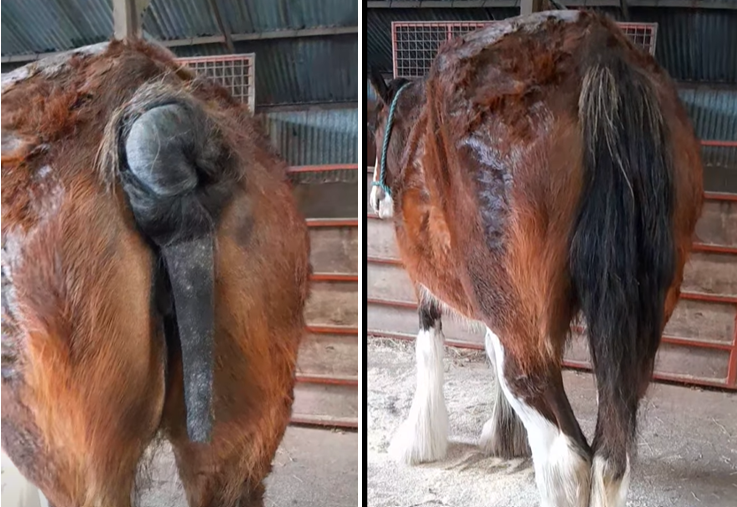
Except that the tail hair hanging from the top of the dock is mostly just for show, as the length of the dock, which would swish the tail hair to reach pests, has had all the hair shaved off. Therefore, the horse has no use of its tail.
What the video claims is easily debunked. Here are the issues with what Mr Black is claiming:
1. Anyone who has met a horse fly knows that the quivering of the skin does not see a horse fly on its way. Whereas a good swish of the tail can take a horse fly off. The quiver response is not always an effective means of getting rid of horse flies, or mosquitoes. They need tails for that.
2. Faeces will fall and mares in heat will discharge fluid regardless of the tail being long or shaved. These fluids will still fall on the horse's legs, and flies will still be attracted to them. Hence why a tail to swish the pests away is so important. The only thing accomplished by "reducing the burden" of the tail is less work for the owner in cleaning it off. Any decent horse owner of any breed of horse knows that cleaning tail of mess is part of caring for a horse.

Here's a sad example of a heavy horse with a docked tail in the US at auction, and legs caked in filth.
This horse is worse off for not having use of its long tail, as flies will be attracted to the filth on its legs, but it has no tail to swat them off.
The same applies for horses with docks with tail hair shaved off.
3. It would be entirely possibly to "reduce the burden" of the tail for hygiene purposes by "reducing" the hair only on the sides of the dock or thinning the tail, leaving a length of hair atop the dock so that when the horse swishes it's dock, there's actually hair attached to swish off the flies. Swishing a hairless dock will not provide this function.
4. The video omits pointing out one rather important thing when Black claims the horse has use of a tail upon releasing the tied-up bun after a show. The "fan" of hair that is released does not connect to the length of the dock, which is the muscle that is used to swish the tail to swat at flies.
5. Hygiene for mares in heat, or about to foal, can easily be remedied by wrapping the upper part of the tail. It is what many breeders do. There is simply no need to drastically remove the function of a horse's tail as Mr Black demonstrated. He didn't mention the hygiene benefits for geldings/stallions, so for them it must just be the poop that justifies removing the use of their tail...
7. There are other heavy horse breeds, such as the Suffolk Punch, also an endangered breed, that you will never see with a shaved tail, and many Clydesdale owners who are appalled by the practice of shaving off the horses' tail hair.
8. Mr Black made clear the intentions behind shaving off the tail hair when he admitted the following in the episode of 'This Farming Life' that featured the Black family; "We're showing this filly at the Highland Show. She's only one. Normally you show them like this with a full tail... so we think she has very good legs on her so we're going to take the tail off, well I'm going to take the tail off - the only snag is once we do it, it takes about three years to grow back in.”
That is what Pete Black stated in series 5, episode 4 of "This Farming Life", seen at 27 minutes of the program.
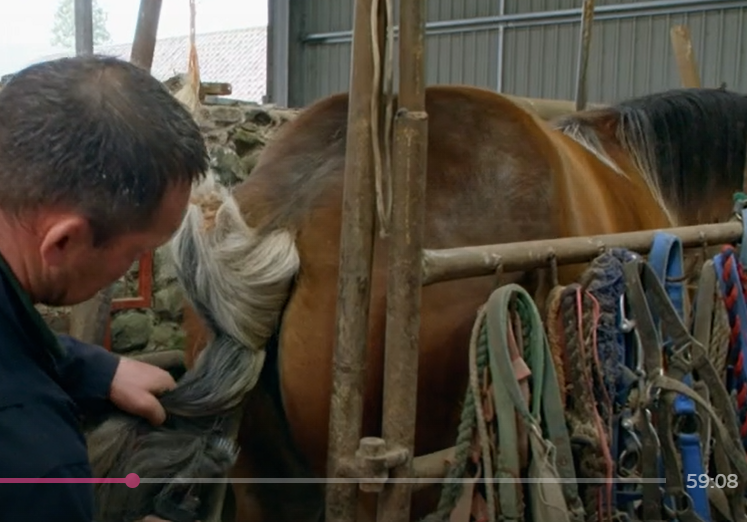
In watching the filly’s tail getting shaved, you can see her tuck her haunches in, trying to move away from the clippers.
The narrator goes on to say "Traditionally, Clydesdales had their tails cut at working age to stop them getting caught in machinery. Today, it's purely cosmetic. A young pre-working age Clydesdale is normally shown with a full tail, but Pete's ploughing his own furrough." Pete goes on to say "You can tell I'm not 100% sure I should be doing this".
When he calls his dad Ronnie Black in to see the "butchering" of the filly's tail,
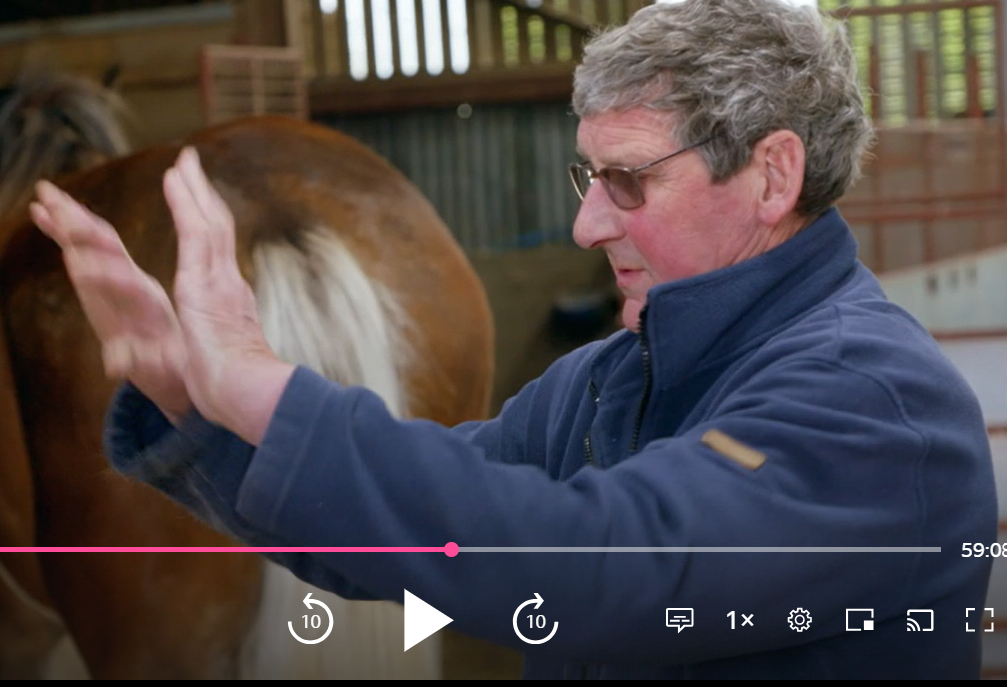
Ronnie Black comments, "Oh my god. Shows off the bottoms, yeah. Good, it's lovely."
In the following episode 5, season 5 at 39 minutes, you can see Mr Black showing his yearlings at the Royal Highland Show. The narrator says, "In a bid to stand out, Pete's taken a risk by giving their tails a dramatic makeover" during which he comments "By looking around, we're the only ones of this age that have done that to their tails, so our presentation is going to be different to everyone else, which isn't ideal, but if we're different, good different, then we're fine."
We have challenged the Clydesdale Horse Society and the Shire Horse Society on their ongoing practice of shaving the tail off the dock for showing purposes, citing the stance of equine professionals and vets that the tail should not be shaved unless medically necessary.
There's no question that the CHS and SHS are intent on clinging to a tradition that deprived heavy horses of their tails, a practice that is no longer about safety, as was the traditional reason given, but about showing off the hind end for judges.
This has been made abundantly clear as they’ve already admitted the purpose is to "show off the bottoms" and hind legs.
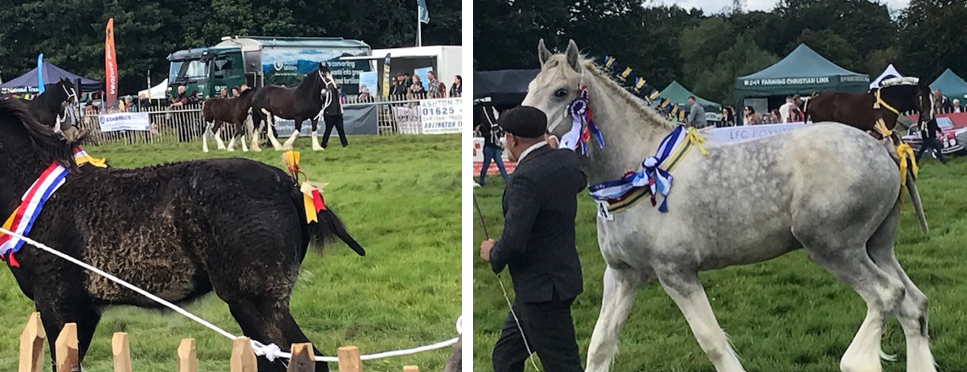
This reason has been proven when Shire foals as young as 5 months old are shown with shaved docks.
We do not question that the Black family and most Clydesdale owners love their horses and, overall, the horses get excellent care. It is not our intention to pick on the Black family, who are no doubt lovely people, or others. But they are promoting a practice that deprives horses the important use of their tails, and it is clearly for aesthetic reasons, not safety, not hygiene.
Depriving any animal of a part of themselves that is essential in how they communicate, interact, and protect themselves cannot and must not be condoned, especially when only done for aesthetic purpose. Plaiting the tail is a safe alternative that causes no harm and achieves the intended purpose of showing off the hind end of the horse, as well as keeping it out of harm’s way if conditions require.
Below, you will see the Spring Newsletter from the Clydesdale Horse Society, acquired from an anonymous whistle blower.
In it, you will see they are seeking to appease the Scottish Government by setting out regulations to not present Clydesdales under 3 years of age with shaved tails at certain shows.
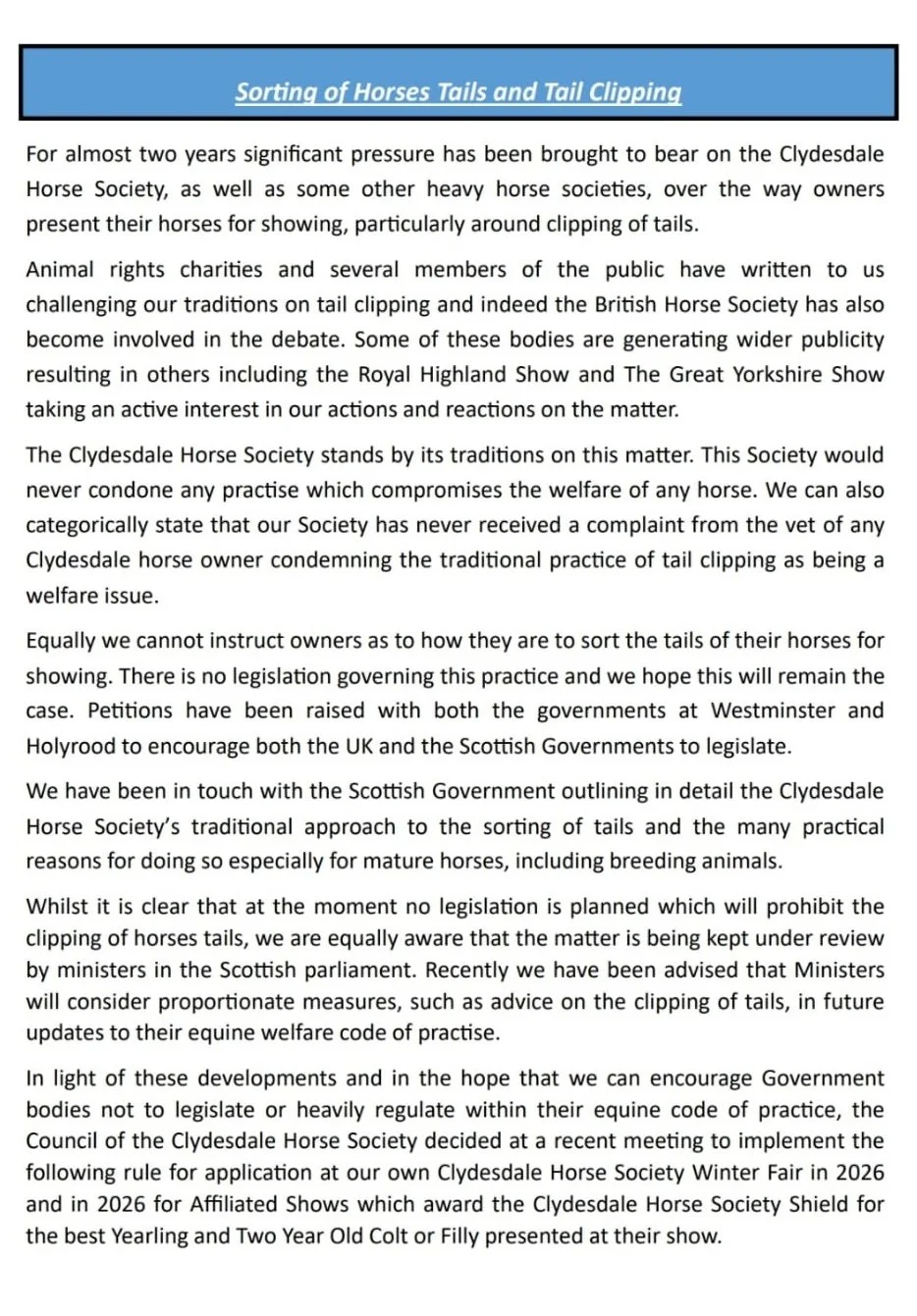
(We are pleased to see attempts to swat us away like flies hasn’t worked!)

In Animal Concern’s submissions to Minister Fairlie and the Scottish Government, we have given much to give due consideration about in deciding the future of shaving tail hair off horses.
In response to the petition, Minister Fairlie had the good sense to write;
“From an animal welfare perspective, a horse uses its tail as a means of protecting its rear end from flies and insect bites, as well as a means of self-cooling and to communicate emotions to other equines. Accordingly, given the importance of the tail to equine wellbeing, the Scottish Government would strongly recommend braiding as an alternative to complete removal.”
It is our stance that guidance will not be enough to ensure members of the CHS and SHS recognise that best practice for all horses being shown is to not remove the tail, but to plait it.
As the Scottish Government prepares to publish the revised Equine Guidance, we have pressed them to take greater measures in ensuring an end to the unnecessary practice of shaving the docks of horses tails unless medically necessary.