With another winter fast approaching, the chances of intervention to prevent another season of prolonged suffering from starvation for the sheep is dwindling.
When the Scottish Government came to the opinion that the sheep of St Kilda should be considered “wild” due to the perception of “living in a wild state”, it sentenced the sheep to decades of annual suffering due to no intervention of the population that would grow beyond the island’s carrying capacity, leading to events of mass deaths through starvation.
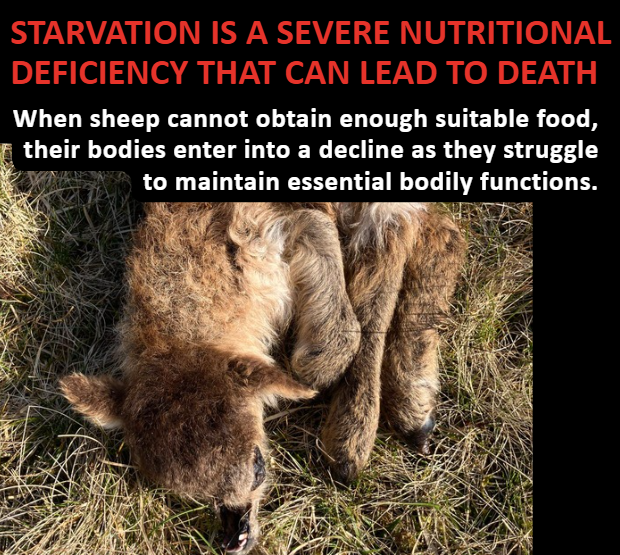
"Because of the duration of suffering experienced during fatal starvation, it is considered one of the most severe types of animal welfare issues encountered in veterinary forensic practice. With hundreds (average around 600) of adult sheep and lambs starving to death each year, the total extent of annual suffering in these sheep on St Kilda is almost incomprehensible."
Professor Ranald Munro, veterinary pathologist
On Monday, 19th October, the Scottish Animal Welfare Commission (SAWC) finally published its long awaited report that was commissioned by the Chief Veterinary Officer, Sheila Voas. A report that was due to be published in July.
The time spent on the report was not wasted by the SAWC team. It is incredibly lengthy, and identifies multiple potential options for managing the sheep population. Each suggestion for managing the sheep comes with its own set of challenges, with proposals ranging from feeding the sheep, to sterilising them, to moving them off the island, to culling them.
With so much focus on variables, whether the sheep are best left to live a life of 'agency' until they perish from starvation, (which the report mistakenly infers is a 'natural' death for these sheep), or have human intervention which may cause the sheep stress in one way or another, it can be easy to lose sight of the one thing that is central to the situation, which SAWC notes in the final pages of the report under 'Ethical concerns around the welfare of feral animals':
' …. the introduction of feral animals by humans onto isolated, island locations from which they cannot escape is a particular case where there is a specific ethical duty for humans to give additional consideration to mitigation of their suffering, compared to wild herbivores which could have arrived there naturally.'
The sheep were abandoned to the island of St Kilda by humans. The tragic occurrence of starvation each winter is a direct result of this, and it must be humans who now take responsibility to ensure these sheep do not continue to suffer.
Our recent FOI request to University of Edinburgh for the most recent count of the sheep population came back with an increase of nearly 400 as of August 2026.
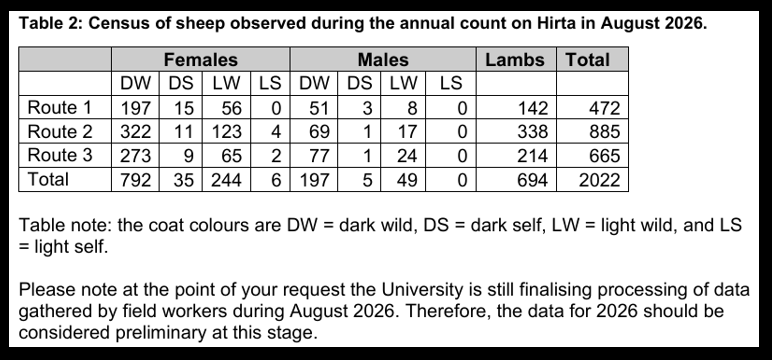
Population growth on an island with limited carrying capacity means that this increase in the sheep population, likely from favourable feeding opportunities in summer months, will see an increase in the number of sheep that will slowly die of starvation this winter as food becomes too scarce to feed much more than half of the 2022 sheep going into winter.
The Soay Sheep Project has data going back to 1985, in which Prof T. H. Clutton-Brock, who started the project, states in Soay Sheep (2004):
'… when the total number of sheep on Hirta exceeds approximately 1150, a high proportion of animals may die - in some cases over two-thirds of the population … The immediate cause of death in late winter is almost always starvation’
For too long, the Scottish Government has maintained that the sheep of St Kilda are 'wild'. Evidence exists to the contrary. The sheep are feral, and should be protected as all other sheep in Scotland are under the Animal Welfare (Scotland) Act 2006.
St Kilda, along with the sheep, was gifted to the National Trust for Scotland. They hold an obligation to take measures to prevent suffering of these sheep.
Any option pursued MUST be the one that most benefits the sheep long term and causes the least harm.
Please visit 'St Kilda's Starving Sheep' for further information prior to writing.
The below footage shows what these sheep experience.
WARNING: the content is distressing.
Veterinarians David Buckland and Graham Charlesworth are not giving up on the sheep of St Kilda, and we are supporting their ongoing efforts to ensure humane and ethical solutions to end the annual cycle of suffering.
We have launched a Crowdfunder page to help fund the next stages. If you are able to donate, please do, or share with someone who is in a position to do so.
Please don't hesitate to get in touch if you have any questions, or want to help further.
You can learn more St Kilda's Starving Sheep — Animal Concern